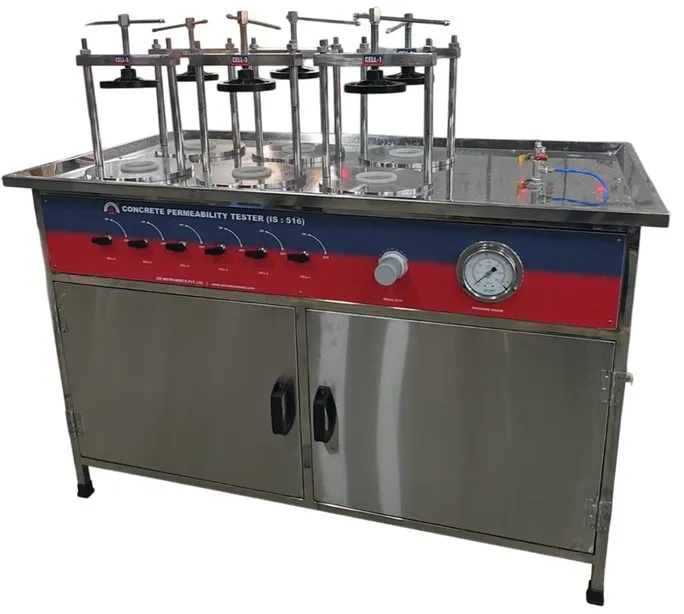
CONCRETE PERMEABILITY TESTER - 6 CELL - COMPACT
Model Number : TM-139-D-6S
Compliance Standards : IS 516 (Part 2/Sec1): 2018, BS EN 12390 (PART 8). Applications : Water Penetration testing machine is at 6 points to determine the depth of penetration of the water into the concrete (impermeability) under known time and pressure. An operator can test any - Concrete cylinder of size 150 mm dia. X 160 mm high or cube moulds of 150 x 150 x 150 mm dimensions. Supplied complete with necessary Spanners and Air compressor of required capacity. Moulds are available at extra cost
Compliance Standards:
IS 516 (Part 2/Sec1): 2018 | BS EN 12390 (Part-8), ISO 7031, UNI 9533
Summary
Concrete Impermeability Apparatus consists of a chamber where the concrete sample is placed, and pressure is applied to force water or other fluids through the concrete. The unit accepts concrete cubic, cylindrical, or prismatic specimens having dimensions up to 200 x 200 x 200 mm. The specimen is placed between the quick clamping chamber and the special circular gaskets. The water is under controlled pressure by a fully automatic Air Compressor with a precision pressure control. The water penetrated is measured by splitting the specimen into half. By measuring the rate or amount of fluid that penetrates the concrete, engineers can assess its impermeability, which is an important factor in determining the durability and lifespan of concrete structures.
Key Features and Benefits
- Robust Construction: Constructed from premium-grade materials for enhanced durability.
- Stainless steel (304 grade) specimen holders resist corrosion and maintain structural integrity.
- Fitted with high-quality air and water pressure gauges for precise readings.
- Equipped with brass water valves to prevent rusting and ensure smooth operation.
- Capable of applying and maintaining up to 7 kg/cm2 pressure for up to 72 hours, ensuring accurate testing conditions.
- Supports six (6) specimen holders, accommodating 150 mm cube or cylindrical specimens.
- Designed to apply water pressure from the bottom of the specimen, replicating realistic conditions.
- Each specimen holder features a single spindle for easy tightening or loosening of the specimen.
- Includes sealing rings at the bottom of each holder to prevent water leakage.
- Specimen holders are mounted on a stainless steel platform to collect dripped water.
- The platform includes a strategically positioned drainage system with a hole and drain pipe for easy water removal.
| Overall Dimensions | 1500 x 800 x 1300(L X W X D) mm |
|---|---|
| Net weight (in kg) | 150 kgs |